Mind maps for revision
Re-reading notes feels productive and isn't. Turning notes into a mind map is better, because you have to decide what matters and where it belongs. Testing yourself on the map is better still.
- One map per topic or unit. Cell biology, not Biology.
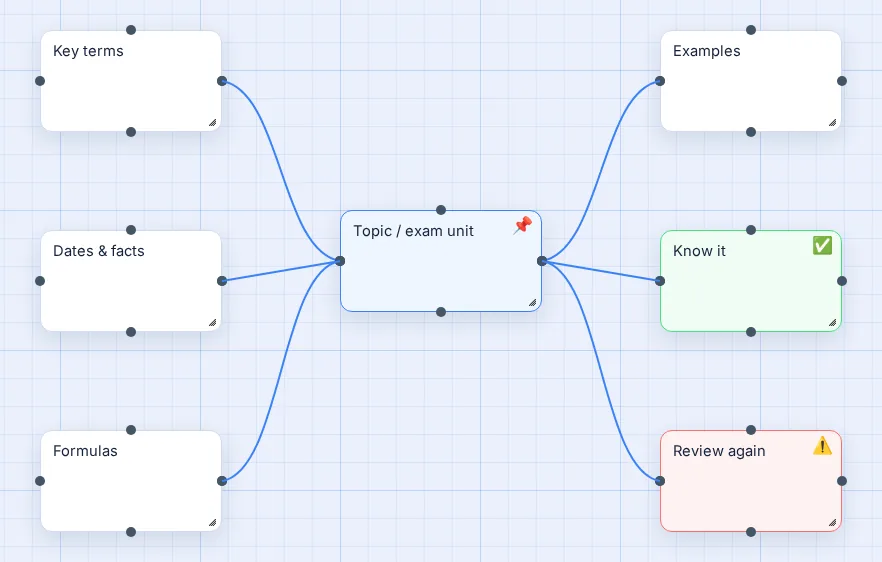
- Branches by type: key terms, dates and facts, formulas, examples, and the questions you keep getting wrong.
- Keywords only. If you can't fit it in a few words, you haven't understood it yet. That's useful to know.
- Sort by confidence. Drag each item under Know it or Review again, or colour it green or red.
- Redraw from memory. A few days later, open a blank canvas, rebuild the map without looking, then compare. Whatever you missed is your next study session.
Mind maps for essays
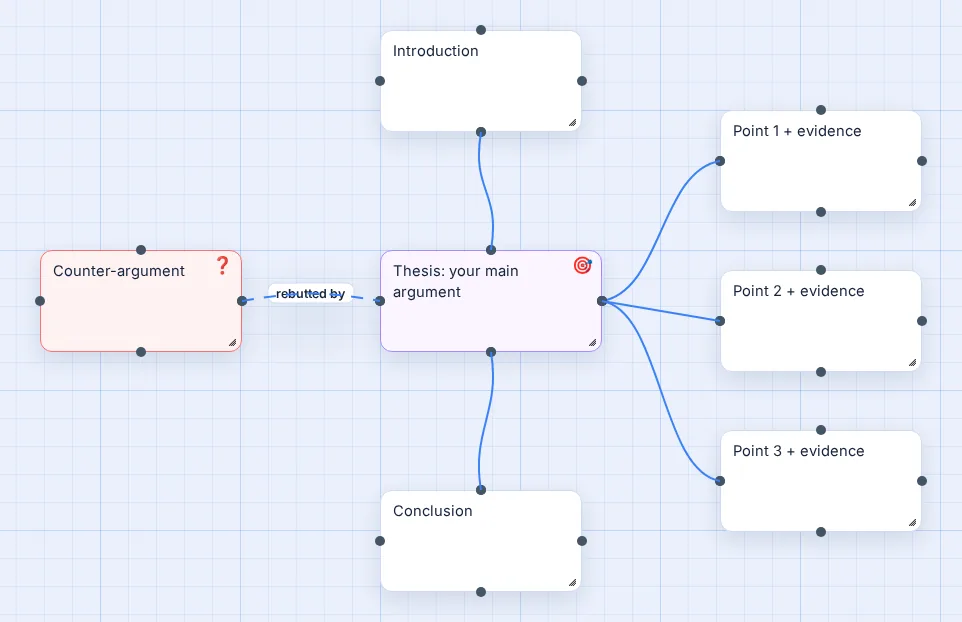
A mind map is the quickest way to see whether an essay has a structure before you write 2,000 words of it.
- Argumentative essays: thesis in the centre, three or four supporting points, evidence under each, and a counter-argument branch with your rebuttal.
- Narrative essays and stories: the central event in the middle; branches for characters, setting, conflict, turning point and ending.
- Research papers: the research question in the centre; branches for each source or theme, with quotes and page numbers as leaves.
- Literature and poems: the text in the centre; branches for themes, language, structure and context, each with quotes.
Mind maps for note-taking
In a lecture or while reading, start with the title in the centre and add a branch every time the topic shifts. Afterwards, spend five minutes cleaning up: merge duplicates, add links between ideas, and click Tidy Up. Each node can hold rich text, lists, links and images, so the details don't have to be lost.
For teachers
- Share a read-only link to a topic map at the start of a unit; nobody needs an account to view it.
- Ask students to build a concept map to check understanding. The labelled links show exactly where the misconceptions are.
- Use it on the classroom screen: it works in any modern browser, and on tablets with touch.
Questions people ask
Do mind maps really help you study?
For many students, yes. Building a map makes you pick out the key ideas and decide how they connect, which is active work rather than passive re-reading. They help most when you then test yourself: cover the map and redraw it from memory, and the gaps show you what to review.
How do I make a mind map for revision?
Put the exam topic or unit in the centre. Add a branch for each subtopic, with key terms, dates, formulas and examples as short leaves. Colour code by confidence, for example green for known and red for review again, and redraw the map from memory a few days later.
How do I mind map an essay?
Put your thesis or the essay question in the centre. Make each main branch one argument or paragraph, with evidence and quotes as sub-branches, and add a counter-argument branch. Number the branches in the order you will write them, then write one paragraph per branch.
Is it free, and do students need an email?
It is free, and no email is needed to try it: maps made in guest mode are kept in the browser. An account (username and password) is only needed to save maps to the cloud and share them.
Can teachers share a mind map with a class?
Yes. Save the map, click Share and send the read-only link. Students can open it on any device without an account, and the teacher can revoke the link at any time with Stop Sharing.
Mind map or concept map for studying?
Use a mind map to summarise a topic quickly and a concept map to understand how the parts of a system relate, for example in biology or nursing. A concept map labels every link, which makes you explain the relationship rather than just note it.