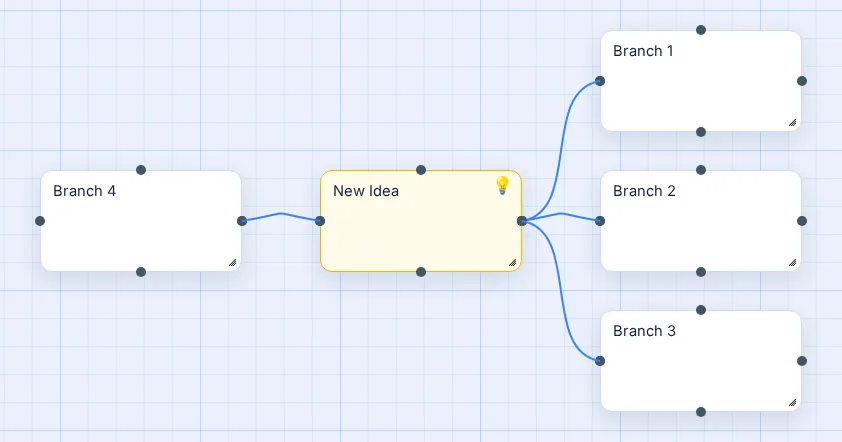
Why brainstorm on a map instead of a list
A list puts ideas in the order you had them. A map puts them where they belong, and you can see clusters, gaps and connections that a list hides. When a new idea relates to something you wrote five minutes ago, you drop it next to it instead of at the bottom.
A 20-minute brainstorm that actually works
- Frame it (1 minute). Write a specific question in the centre: How could we get our first 100 customers? beats Marketing.
- Go wide (10 minutes). Add every idea as a branch, including the silly ones. Select the centre and press Tab for a new branch; press Enter for another at the same level. No editing, no judging.
- Cluster (4 minutes). Drag related ideas together and give each cluster a parent branch, such as Partnerships or Content. Shift+drag selects a group to move it in one go.
- Connect and colour (3 minutes). Colour each cluster. Draw lines between ideas that feed each other.
- Choose (2 minutes). Tag the best two or three with the ⭐ or 🎯 icon, click Tidy Up, and export a PNG or turn the winners into a project plan.
Brainstorming techniques to try on a map
| Technique | How to map it |
|---|---|
| Starbursting | Centre = the idea. Six branches: Who, What, Where, When, Why, How. Fill each with questions, not answers. |
| SCAMPER | Centre = an existing product or process. Seven branches: Substitute, Combine, Adapt, Modify, Put to another use, Eliminate, Reverse. |
| Reverse brainstorming | Centre = How could we make this worse? Then flip each bad idea into a fix. |
| 5 Whys | A chain: problem, then why? five times, each answer a child of the last. The end of the chain is the root cause. |
| SWOT | Four branches around a decision. There's a ready-made SWOT template. |
Who uses it for what
- Writers: plots, characters and article outlines.
- Students: essay ideas and project topics. See mind maps for students.
- Small businesses: product names, marketing ideas, what to fix first.
- Anyone stuck: a messy problem broken into pieces you can actually act on.
Honest limit: there's no real-time co-editing. Brainstorm on your own, then share a read-only link or a PNG with the group.
Questions people ask
What is the best free online brainstorming tool?
The best one is the one that gets out of your way: it captures ideas as fast as you think, lets you rearrange them freely and needs no setup. Vision Mapr is free, needs no account to start, and adds ideas from the keyboard with Tab and Enter. For live workshops with many people editing at once, a collaborative whiteboard suits better.
How do you brainstorm with a mind map?
Put the problem or question in the centre. Spend ten minutes adding every idea as a branch with no judging. Then sort: group similar ideas under shared branches, colour the groups, draw links between related ideas, and mark the two or three worth taking forward.
Can I brainstorm with a team in Vision Mapr?
You can share a read-only link so others can see the map, or put it on a shared screen during a meeting. Vision Mapr does not have real-time co-editing, so for a remote workshop where everyone types at once, a collaborative whiteboard tool is the better fit.
What are good brainstorming techniques?
Timed free-writing (quantity first), mind mapping, starbursting (asking who, what, where, when, why and how), SCAMPER (substitute, combine, adapt, modify, put to another use, eliminate, reverse), reverse brainstorming (how could we make this worse?) and the 5 Whys for root causes.
Is brainstorming better alone or in a group?
Research suggests people often generate more ideas alone than in a talking group, because groups wait their turn and drift toward one voice. A good pattern is to brainstorm alone first, then combine and discuss everyone's maps together.